Will an AI Chatbot Save More than a Receptionist?
Explore whether switching from a human receptionist to an AI chatbot delivers real cost savings. See how coverage, lead capture, and revenue recovery compare.

Choosing between an AI chatbot and a human receptionist comes down to more than simple payroll math. After reading this post, you’ll understand when AI makes sense, how fast you could see savings, what calls truly require a human, and which hybrid options deliver a balanced approach. You’ll weigh real cost-saving scenarios for your business—not just annual salary comparisons, but also the value of 24/7 coverage and the calls you never even knew you missed.
Cost Savings: Breaking Down AI Chatbot Versus Human Receptionist
Let’s get straight to the point: a traditional receptionist draws a regular paycheck. Costs stack up from wages, benefits, office space, and downtime. An AI agent, whether on voice or text, usually charges a monthly fee tied to usage. The main expense is software and perhaps a per-minute or per-interaction charge for voice support. The potential savings show up wherever a human receptionist’s schedule and bandwidth fall short. Think after-hours coverage, lunch breaks, sick days, or holidays when the phone still rings and the website stays live.
| Cost Area | Human Receptionist | AI Chatbot/Agent |
|---|---|---|
| Base Cost | Hourly wage plus benefits | Monthly software fee |
| Availability | 40 hours/week + breaks, vacations, absences | 24/7 if needed, no breaks |
| Language Coverage | Limited to staff’s skills | Multi-language by default |
| Lead Capture Consistency | Varies with workload, mood | Consistent & tireless |
| Missed Calls/Chats | Likely after hours or during busy spikes | Rare to never, 24/7 response |
| Scalability | One call or chat at a time | Many chats at once, instant scale-up for spikes |
Most businesses start to see real savings from an AI receptionist when “dead time” on payroll—the paid hours not spent on actual conversations—outweighs the software fee. For busy businesses or those with volume swings, AI closes the coverage gap fast.
Where’s the Break-Even Point on Call or Chat Volume?
The true breakeven depends on your pay rates and platform costs. Here’s a rule of thumb: if your receptionist spends more than half their paid time waiting for the next call, the hourly cost of “just-in-case” coverage starts to exceed that of an AI agent fielding every website or phone visitor, all the time.
Take a typical service business. A receptionist covering 8 hours a day might get 20-30 calls and a handful of web chats. If it costs $3,000 a month for a full-time employee and $100 a month for an AI with voice and chat, a business doing less than 150-200 calls or chats per month pays significantly less with an AI agent. The break-even call volume could be even lower if your business sees sudden bursts—such as emergencies, after-hours requests, or multiple simultaneous inquiries. AI scales instantly, while human receptionists may put callers on hold or send them to voicemail.
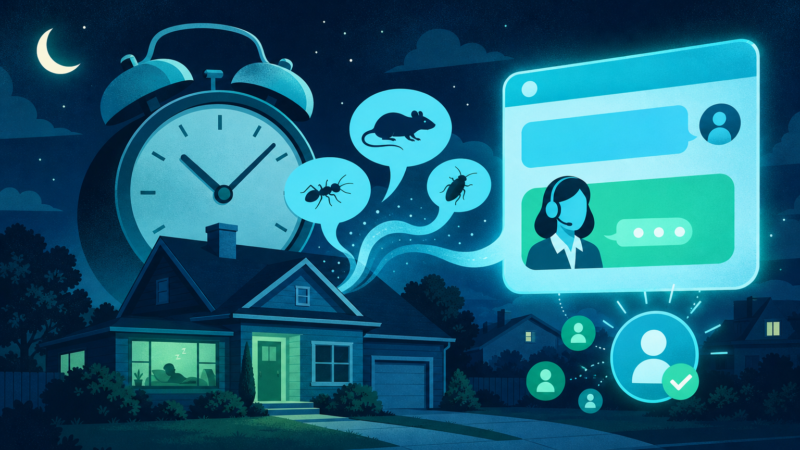
One overlooked point: recover the revenue that vanishes every time a customer can’t reach you after hours. AI covers those silent, off-clock moments. It captures leads while your competition sleeps.
How Quickly Can You Recoup the Cost?
The payback period for switching part or all of your coverage to an AI receptionist is often measured in months, sometimes less. Every missed caller or chat on your website is a lost lead or client. That means the switch to AI can pay for itself the moment those missed inquiries turn into a booked service or appointment.
- Add Up Your Monthly Receptionist Costs. Include all expenses: salary, benefits, workspace, and equipment.
- Project Your AI Agent’s Monthly Cost. Add up the basic monthly fee and any expected usage overages (such as voice minutes or post volume).
- Estimate How Many Leads You Miss Each Week. Consider after-hours calls, chats during lunch or meetings, and any unreturned voicemails.
- Calculate the Value of a Single Recovered Lead. How much is one additional case, appointment, or job worth?
- Subtract AI Cost from Human Cost, Then Divide by Lead Value. If you break even after converting just one or two leads that would have been missed each month, you’re in the payback zone.
If your business depends on first touch—where a visitor’s call or web chat may be their only shot before they try a competitor—these numbers are even more persuasive. You can’t act on what you don’t capture.
Revenue Recovered: The Real Value of 24/7 AI Reception
Saving money is only half the story. AI brings in leads you’d never see otherwise, especially after hours. A clinic that misses evening calls loses those bookings to whoever answers. A local home services pro who can’t take a call at 8 p.m. loses that job to a faster responder. AI doesn’t just cost less; it means lost revenue isn’t left on the table overnight, during weekends, or busy spells.
On the website side, every unanswered chat is an abandoned cart in the making. Read more about why service industry websites miss leads—not just calls—and how AI plugins that combine chat and voice ensure lead capture even when your team is heads-down elsewhere.
Human Limitations and Where a Hybrid Model Matters
Even the best AI can hit practical boundaries. Some scenarios—such as grieving families calling a healthcare practice, a client urgently needing legal advice for a complex dispute, or someone expressing anger or distress—call for a human’s emotional sensitivity and problem-solving ability. No AI, no matter how advanced, can fully replicate empathy for complex, emotional, or nuanced issues.
This is where a hybrid model comes into play. For businesses that routinely see these high-stakes or emotionally loaded contacts, an AI agent can triage: cover routine questions, capture urgent details, and escalate calls that obviously need a human’s touch. This approach delivers both 24/7 efficiency and the assurance that tricky cases never get mishandled or ignored.
- AI handles the predictable stuff: hours, booking, service questions, gathering contact info, and follow-up details.
- Human staff gets paged or notified for anything sensitive, complex, or flagged by the system as requiring care beyond AI.
This model isn’t about replacing people. It’s about letting your human team focus on the situations where empathy, judgment, and expertise matter most. Many practices—especially in health and medical fields or other high-trust service sectors—realize actual cost savings by blending AI with human backup instead of relying on AI alone.
Chatbot vs Receptionist Cost Savings: What’s Right for Your Business?
To sum up: a business starts to see real savings from an AI agent at the point where paid human downtime, missed calls or chats, and the value of every “just-in-case” receptionist shift exceeds the monthly software fee. For most service businesses that field more than a handful of daily inquiries—especially those with after-hours demand—the cost advantage tilts heavily toward AI.
But savings aren’t just about spending less. AI means lost leads and missed revenue get recovered, the visitor experience gets more consistent, and your human team gets reserved for the moments that actually need their skill or heart.
If you’d like to see what smarter, always-on website coverage could do for you—with zero risk—try SiteStaffr’s 30-day free trial to discover how much more you could be capturing starting next week.