Pest Control Virtual Assistant: Answering Customers on Your Website at Night
Discover how a pest control virtual assistant can capture after-hours leads, answer urgent customer questions, and keep your pest control business competitive 24/7.
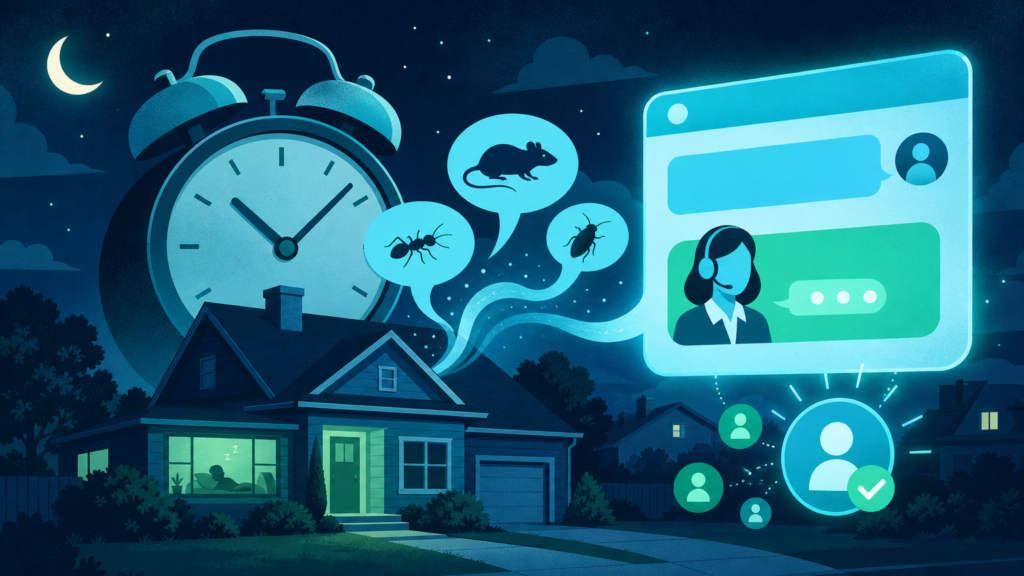
If your pest control business is missing inquiries after 5 p.m., you’re probably bleeding leads—at exactly the hour your future customers need you most. A pest control virtual assistant for your website answers questions and captures contact info for you, no matter the hour. This way, nobody waits till morning or clicks a competitor. Let’s look at why handling nighttime website chats is make-or-break for pest control firms—and how a chat- and voice-based virtual assistant solves it.
What exactly is a pest control virtual assistant?
A pest control virtual assistant is an AI-powered agent on your website—accessible through chat or voice—that engages visitors, answers common questions, and captures leads in real time. Unlike a general “virtual assistant” or outsourced call service, it’s built for pest control specifics: services, pricing, availability, and urgent issues. The difference matters. Pest control is an emotional business; when someone has roaches in the kitchen at 11 p.m., they want clear, empathetic answers and a way to book help, not a vague promise that an agent will call them back tomorrow.
Where a general AI assistant might fumble site-specific questions or miss local context, the right pest control solution works with your precise content—service area, techniques, hours, guarantees—so it gives visitors facts instead of guesses. It can also complete key tasks: check service eligibility, collect location and contact info, and confirm that your team will follow up. You can see more core capabilities at the features page.
Why is after-hours response so critical for pest control leads?
Pest control is a classic “I need help now” industry. Late-night noises, ant trails across the stove, or fresh droppings in the attic drive urgent searches—and whoever answers first gets the business.
The trouble is, most firms go dark after 5 p.m. The numbers are plain: home service companies miss 84% of phone calls after hours, compared to just 29% in the day. Those missed calls are worth an average of $78,400 in lost revenue per business, every year.
And the problem isn’t just phone: 40% of home service website chats arrive after hours, and 21% on weekends. When nobody answers the website at night, you aren’t just missing a few requests—you’re leaving your lead pipeline half-empty when people are most motivated to book.
If you’re wondering what that means for your business, you’ll find more detail in this post on the true cost of missed web chats.
What information should the assistant capture?
When someone comes to your website at 9 p.m. panicked about a rat sighting, the virtual assistant needs to do more than just greet them. At a minimum, it should:
- Understand what kind of pest and which area of the property is affected.
- Collect the visitor’s name, phone number, and/or email—at least two ways to contact them.
- Confirm their address or service location if relevant.
- Record timing needs: is it an emergency, or are they seeking a quote for next week?
- Provide clear next steps (“Our team will call you first thing in the morning”).
The assistant should also log a full conversation transcript and summary, delivered to you instantly, so you enter the morning with a list of ready-to-call leads and exactly what they need.
For pest control businesses, accuracy matters—if your online assistant fumbles details (“we treat all pets”), or can’t distinguish between a termite emergency and a routine mosquito spray, you risk both lost bookings and bad impressions.
How quickly should inquiries be answered to maximize bookings?
The expectation for web chat is brutal: 58% of consumers expect a reply in under two minutes. For most pest sites, especially after hours, a delay of 10 minutes—or waiting until morning—means that lead is gone.
Speed matters because urgency drives action. Visitors with a live pest crisis are not shopping around; they’re getting help from the first company that says “We’ve got you, tell me your number, you’ll be called first in the morning.” If your system answers instantly, captures their number, and promises specific follow-up, you’re fighting off competitors. You do this without ever picking up the phone at midnight.
How does urgency and emotion in pest control drive conversion rates?
Pest problems spike after hours. By the time someone’s searching for “ant control near me” at 8:45 p.m., frustration or embarrassment may be high—and the sense of crisis strong enough that price shopping becomes secondary.
This emotional urgency flips the script on lead conversion. Instead of a polite, patient buyer, you have someone whose “problem solved” feeling is triggered as soon as you give them clarity and a plan.
A chat or voice assistant that can greet with warmth (“That sounds stressful. I’ll get this to the team first thing; what’s the best number to reach you?”) taps into this urgency. By responding conversationally, using real local knowledge, and confirming clear next steps, it turns late-night site visits into locked-in opportunities instead of lost chances. If you want to read more about how multilingual chat also meets visitors where they are, see key chat support features here.
What’s the typical ROI of capturing after-hours pest control leads?
The economics are blunt: lost leads at night are lost revenue. An after-hours mouse call or bed bug emergency is often high-value. Repeat business or word-of-mouth comes from who solved the pain when it was freshest.
Capturing even a handful more after-hours inquiries per month more than covers the cost of most virtual assistant software—because the average pest job isn’t a $50 item, but a multi-visit or recurring relationship.
There’s also an operational upside: a website assistant doesn’t depend on someone being free to answer. Every inquiry gets logged with full context. There’s no 7 a.m. scramble to replay voicemails or piece together what the lead wanted. That means your team starts every shift with a prioritized list of warm leads and transcripts to speed up booking.
If you serve multiple service types beyond pest, or want to see how this applies to other urgent fields, you can find an overview of industries at this service business resource.
How do I set up a virtual assistant like this for my pest control website?
The critical factors to weigh are:
- WordPress plugin installation—shouldn’t require coding, and setup should take minutes inside your dashboard.
- Real pest-control content grounding—the assistant must use your actual services, service areas, and FAQs, not canned generic lines.
- Lead capture and notifications—look for instant recaps delivered to your email (or CRM), capturing all details.
- Multilingual support if your customer base is diverse—so visitors can chat in their language, but you always get English transcripts.
- Voice and chat options—so customers who want to talk, not type, get the same quick answers.
- No API keys or developer steps—install and go, no technical bottlenecks.
From there, configuring your greeting, updating service info, and tailoring question prompts are usually in-menu steps. Some providers will even guide setup over a quick call or email so you can have your assistant running the same day.
FAQ
- What’s the difference between a pest control virtual assistant and a call answering service?
-
A pest control virtual assistant lives on your website, engaging visitors the moment they arrive, 24/7—without call queuing, phone training, or hold music. While call services pick up the phone, a website VA intercepts prospects before they ever phone in, answers questions instantly, and captures key info while the prospect is actively browsing.
- How do I know which leads came from night visitors?
-
Every lead generated by a website assistant should come with a timestamped transcript and summary—showing when the chat happened, what the visitor wanted, and their contact details. This lets you track after-hours ROI and prioritize callback speed in the morning.
- Can a virtual assistant really handle different pest types and service locations?
-
If set up properly, yes. The key is starting with your own site’s service list, treatment types, and coverage area, not generic texts. Well-designed assistants tailor questions and answers to the pests and ZIP codes you cover, never mentioning services you don’t actually offer.
- What about visitors who write in Spanish, Mandarin, or other languages?
-
The best chat assistants handle more than 50 languages for visitors, but always deliver recaps in English so your team can respond promptly. This is essential in diverse areas or for serving customers whose first language isn’t English at night.
- How long does setup actually take?
-
For WordPress users, installation and basic configuration usually takes under five minutes. Further tuning—adjusting greetings, uploading FAQs, integrating with your CRM—can be done as your schedule allows. No coding or developer time should be needed.
- Is there a risk of the AI making promises I can’t keep?
-
Not if you keep your business info up to date in the plugin. Good assistants only promise what you set—like business hours or next available slot—so customers never get misleading info. Always review sample transcripts when you first set up to be sure.
SiteStaffr is an AI receptionist for WordPress sites: it answers your website visitors by voice and text around the clock, captures each lead, and emails you a recap. See how it works for pest control companies, then try it free for 30 days with no credit card. After the trial, the Free plan keeps AI text chat on your site for up to 50 conversations a month.